


Table of Contents (6 sections)
Why Front-Facing Selfies Conceal Application Quality
A front-facing portrait captures overall silhouette and styling. However, lash roots hide in shadow, camera beauty filters smooth out imperfections, and fluffy volume fans can conceal messy adhesive clumps. Technical quality can only be assessed through crisp close-ups with eyes closed and viewing angles along the lash line.
When beauty communities discuss what makes a set good, opinions range from visual symmetry to how the lashes feel during blinking. A macro photograph provides objective technical insight, though it remains one part of an evaluation.
Quality Marker 1: Every Natural Lash Moves Independently
Isolation means that a treated natural lash never sticks to neighboring hairs. In statutory training criteria, such as those from the Minnesota Board of Cosmetology, clean isolation and checking for stuck-together lashes are core evaluation standards.
On a photo, look for separated root attachments. However, an image cannot prove whether two baby lashes are glued together just outside the focal plane. That is why an artist performs thorough tweezer checks through each lash layer before you open your eyes.
Quality Marker 2: Adhesive Bonds Are Small and Seamless
A clean bond does not look like a heavy black bead. The extension or fan stem wraps flush along the natural lash with sufficient contact area, and the cured adhesive envelops the seam smoothly without bleeding into adjacent hairs.
Completely invisible glue is not necessarily a guarantee of quality either. What matters is a secure, fully wrapped bond and good retention, not an artificially microscopic dot that detaches three days later.
Quality Marker 3: Controlled Distance from the Eyelid Margin
Extensions attach to natural lash hair, never directly onto eyelid skin. Cosmetology education standards typically recommend a uniform clearance between 0.5 mm and 1 mm from the lid margin. This provides clearance for natural movement without letting the extension droop.
If an extension is glued to the skin, blinking causes constant friction and irritation. If it sits several millimeters too far out, it looks overgrown immediately and twists under its own weight. A macro image should reveal a clean, skin-free root line.
Quality Marker 4: Controlled Direction and Fan Geometry
| Observation | Possible Explanation | What You Should Do |
|---|---|---|
| Individual lashes crossing over each other harshly | Natural growth direction or inconsistent placement angle | Point it out at your appointment and have it brushed through |
| Multiple volume fans collapsed into solid sticks | Product buildup, sleeping friction, or glue bleeding | Do not pull them apart yourself; schedule a clean-up |
| Outer corner lashes drooping downward | Mapping apex is too far outward for your eye shape | Review mapping lengths and curl lift at your next refill |
| Bases appear bulky or touch eyelid skin | Excessive adhesive or improper placement | Have it examined promptly if you feel any pinching |
Medical literature reviews identify chemical irritation, contact dermatitis, and natural lash damage as potential complications of poorly applied extensions. A photograph cannot diagnose a medical condition; severe pain, redness, swelling, or visual changes require prompt medical attention.
How to Take Meaningful Photos of Your Lashes
- Use soft indirect daylight instead of harsh flash or beauty filters.
- Capture both eyes closed from above and slightly angled from the front.
- Tap your camera screen to focus on the roots rather than the tips.
- Add an open-eye photo to show overall symmetry.
- Note the date and how many days have passed since your appointment.
Must both eyes look 100% mathematically identical?
Symmetry should look balanced to the naked eye. Because natural lash density, growth angle, and eye shape differ slightly between sides, harmonious symmetry comes from tailored adjustments rather than identical maps.
Are visible glue dots always a sign of bad work?
No. A durable bond requires enough adhesive to wrap the natural hair securely. Problematic signs include large rough clumps, skin contact, or lashes stuck together.
Can I separate stuck lash extensions myself with a needle?
Never. Attempting to pry stickies apart at home pulls out natural lash roots and risks severe eye injury. Let a trained artist release them with precision micro-tweezers.
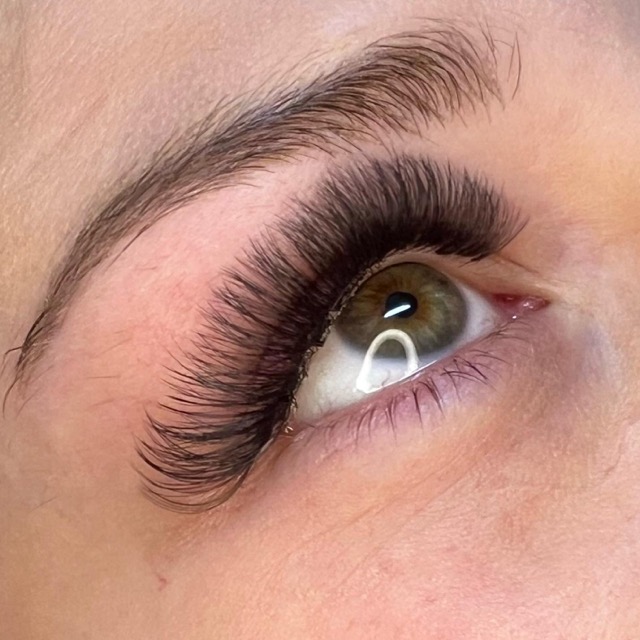
Updated: August 2026. The cover image is an authentic close-up from Sarah Krasnic's studio in Graz.
Sources and notes (3)
All facts and recommendations were verified using official guidelines and scientific sources.