

Table of Contents (6 sections)
Why Different Studios Define 'Wispy' Differently
Booking lash extensions for the first time often feels like wading through a sea of jargon: Classic, Hybrid, Russian Volume, Mega Volume, Wispy, Wet Look, Kim K, Cat Eye, D-Curl. None of these terms are wrong. They simply describe completely different aspects of an appointment and mean slightly different things depending on which salon you visit.
Community discussions frequently show clients feeling confused when asking for 'natural volume' and receiving a dense, dark lash line. This glossary is designed to bridge the gap between salon terms and what you actually see in the mirror.
Application Technique: How Fullness Is Built
Classic (1:1 Technique)
In classic lash application, one extension is attached to one suitable natural eyelash. This can produce an understated, clean appearance. On a client with naturally dense lashes, classic application can look surprisingly dark and defined, while on sparse lashes it appears light and delicate.
Volume
Volume involves crafting a lightweight fan out of several ultra-fine fibers and wrapping it around a single natural lash. More fibers do not automatically mean excessive weight: diameter, fan width, and length must be calculated to match the carrying capacity of each natural lash.
Hybrid
Hybrid blends individual classic extensions with lightweight volume fans across the lash line. This technique fills natural gaps while adding subtle dimension. The overall density depends entirely on the ratio of fans to singles.
Aesthetic Styles: What Texture Do You See?
| Term | Typical Visual Effect | Helpful Question for Your Artist |
|---|---|---|
| Natural | Soft transitions, conservative lengths, close to healthy mascara | Does natural mean barely detectable or clearly polished for daily wear? |
| Wispy | Noticeable spikes rising above a softer, multi-layered baseline | How tall and sharp should the accent spikes stand out? |
| Wet Look | Bundled, glossy spikes reminiscent of freshly applied mascara | Should the lash line look delicate and airy or dark and defined? |
| Anime / Manga | Pronounced, graphic spikes with wide, clean gaps between them | How wearable and bold do you want this geometric shape to be? |
| Fluffy | Airy, soft volume with wide open fans and minimal harsh lines | Are you looking for maximum softness or concentrated root density? |
Style names are shorthand. Bringing a clear inspiration photo alongside two descriptive sentences is far more reliable than relying on a trend word: saying 'I love textured tips, but I do not want a heavy black lash line' gives your artist exact direction.
Mapping: Where Lengths and Curls Are Positioned
Mapping is the blueprint for your eye. It determines where shorter and longer extensions sit to complement your eye shape. Professional styling curricula emphasize eye symmetry, growth direction, eyelid fold, and safe weight distribution.
Doll Eye / Open Eye
The longest extensions are placed above the iris in the center of the eye. This creates an open, awake appearance, though it must be balanced carefully against your eyelid shape.
Cat Eye
Lengths gradually increase toward the outer corners. On downward-sloping outer eye corners, very long outer lashes can drag the eye downward; placing the apex slightly inward often creates a more flattering lift.
Squirrel
The maximum length peaks just before the outer corner, tapering down slightly at the very end. This is often the most universally flattering alternative to a classic cat eye.
Materials: Curls, Lengths, and Diameters Demystified
- Curl denotes the curvature of the synthetic fiber. Letters like C, CC, D, and L represent curvature categories, though exact curves vary slightly between manufacturers.
- Length is measured in millimeters (typically 7 mm to 14 mm). The same millimeter length looks dramatically longer or shorter depending on eye depth and natural curl.
- Thickness represents the diameter of an individual fiber (e.g., 0.05 mm, 0.07 mm, 0.15 mm). It must be evaluated alongside fan size and length to protect natural lash health.
- Color and finish alter contrast. Soft espresso brown creates a subtle, gentle frame, whereas deep black produces high-contrast definition.
When comparing curl letters between different salons, you are not necessarily looking at identical geometry. Focusing on the look you want from the front and side is much more helpful.
Five Sentences That Truly Help During Consultation
- I want to look groomed and polished each morning without looking like I am wearing heavy evening makeup.
- I love these textured tips, but the density in this photo is too heavy for my everyday lifestyle.
- My glasses cannot touch the lash tips when I blink.
- I do not like heavy lengths on my outer eye corners.
- If my natural lashes cannot safely carry this look, let us start with something lighter and build from there.
Is Classic always more natural than Volume?
Not always. A dense classic set on someone with thick natural lashes can look quite bold, while ultra-fine, airy volume fans on fine lashes look soft and subtle. The overall effect depends on length, diameter, and density.
Are Wispy and Wet Look lashes the same?
No. Wispy focuses on uneven peaks and multi-layered texture. Wet Look uses closed, un-fanned lashes that mimic clumped, wet mascara. Sets can blend elements of both.
Which lash curl is the strongest?
D and DD curls have the sharpest upward curve, while L and M curls feature a flat base with an angled lift for hooded lids. Stronger curls are not universally better; they must complement natural growth direction.
Can a lash artist copy an inspiration photo exactly?
Rarely. An image depicts a different eye shape, bone structure, and lash density. Photos serve as inspiration for texture and mood, not as a carbon copy blueprint.
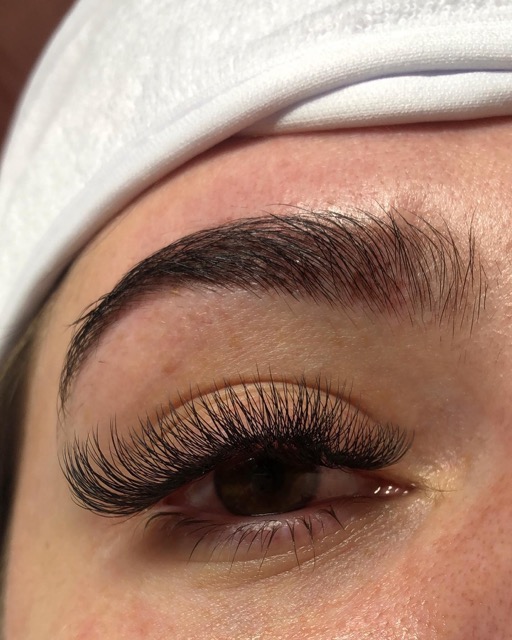
Updated: August 2026. The cover image shows authentic studio work from Sarah Krasnic's portfolio in Graz.
Sources and notes (3)
All facts and recommendations were verified using official guidelines and scientific sources.